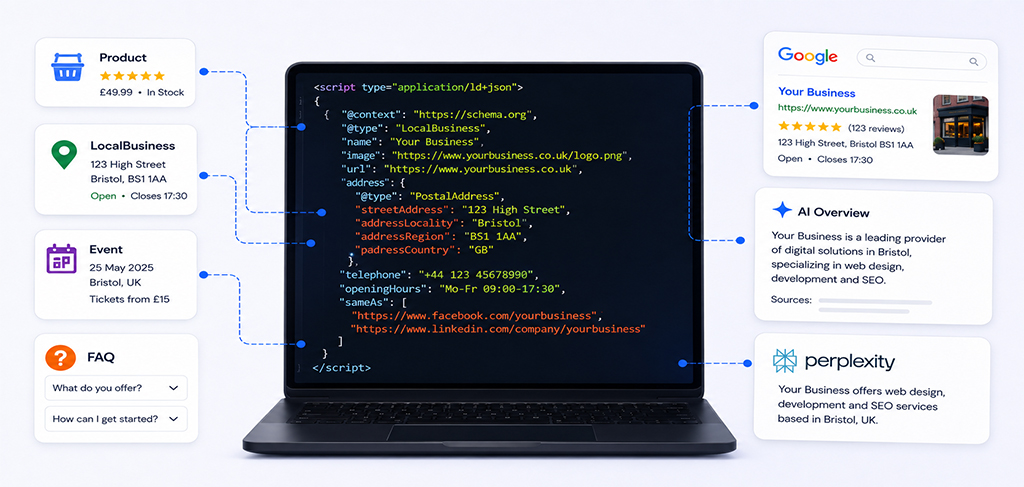
Imagine standing in front of two storefronts on the same street.
The first has a clean glass window showing its open hours, current sales, top-rated products, and customer reviews right on the front door. The second storefront is completely opaque – just a plain wooden door with a small nameplate.
Which door are you going to walk through?
That is precisely what happens on Google’s Search Engine Results Page (SERP) every single day. Most websites are plain wooden doors. They rely on standard blue title links and two lines of meta descriptions, hoping users click through to find out more.
A select group of websites, however, uses Schema markup. They display star ratings, product prices, FAQ dropdowns, prep times, and author credentials directly inside the search results.
HTML tells web browsers how your site should look. Schema markup tells search engines what your content actually means.
If you want to capture more organic traffic, improve brand clarity, and prepare your site for the future of AI search, structured data is no longer optional – it is your highest-leverage technical SEO tactic.
What Is Schema Markup? (A 30-Second Primer)
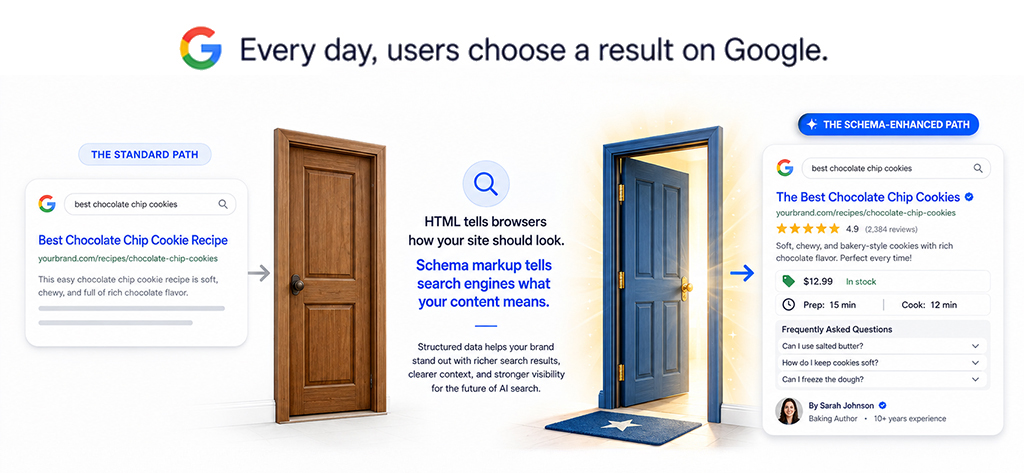
Schema markup – often called structured data – is a standardized vocabulary created by Schema.org (a collaborative project backed by Google, Microsoft, Yahoo, and Yandex). It is code added to your website that helps search engines understand your content in context.
Without schema, a search crawler sees the word “Apple” on a page and has to guess whether you are discussing:
- The tech company headquartered in Cupertino
- The crisp red fruit you buy at the grocery store
- The record label founded by The Beatles
With schema markup, you remove the guessing game entirely. You explicitly tell the search engine: “This entity is an Organization, its headquarters are here, and its official logo is located at this URL.”
4 Reasons Schema Markup Is Your Highest-Leverage SEO Tactic
While structured data isn’t a direct “ranking signal” in the traditional sense, its indirect impacts on visibility, click-through rates, and authority are massive.
1. Massive CTR Boosts with Rich Results
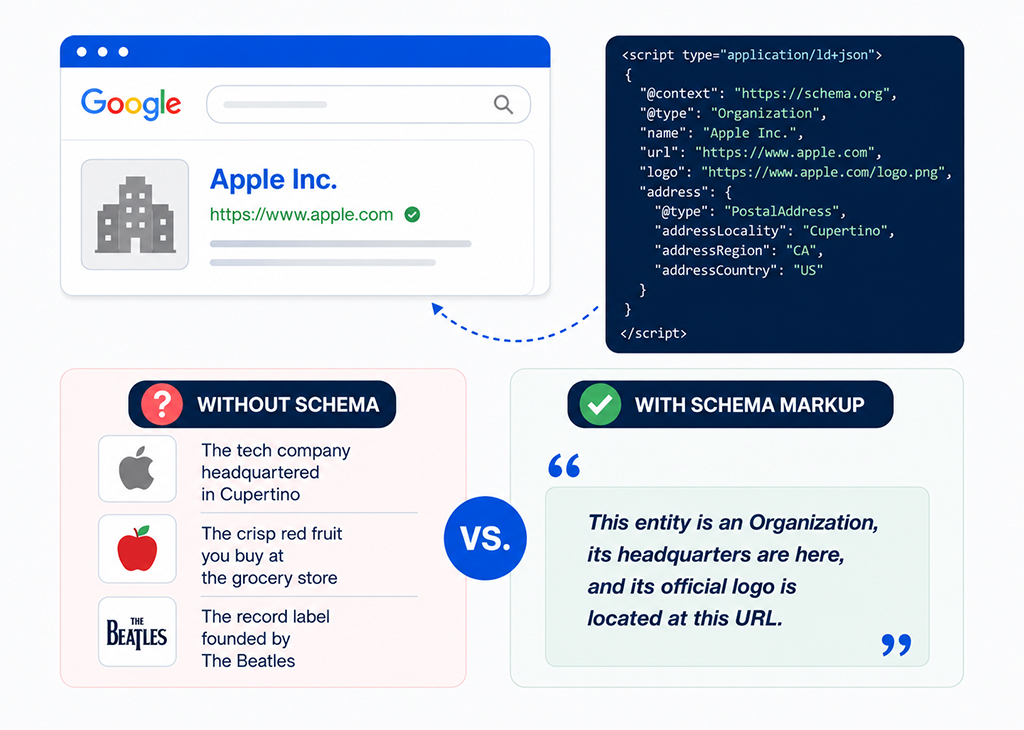
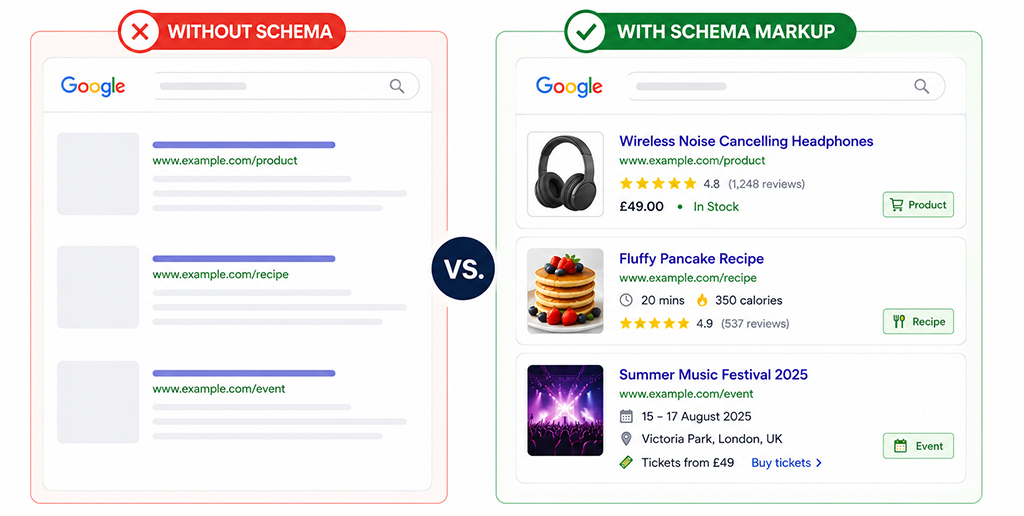
Standard search listings are easy to ignore. Schema markup upgrades standard listings into Rich Results (or Rich Snippets).
Depending on your content type, schema unlocks eye-catching SERP features:
- Product Schema: Displays star ratings, review counts, pricing, and “In Stock” tags.
- Recipe Schema: Shows cooking time, calorie counts, and appetizing thumbnail images.
- Event Schema: Displays dates, locations, and ticket purchasing links right on the results page.
- FAQ Schema: Displays collapsible question-and-answer accordions directly under your listing.
These visual upgrades take up significantly more physical screen real estate, draw the eye, and dramatically increase your Click-Through Rate (CTR).
2. Essential Context for AI Search Engines & Knowledge Graphs
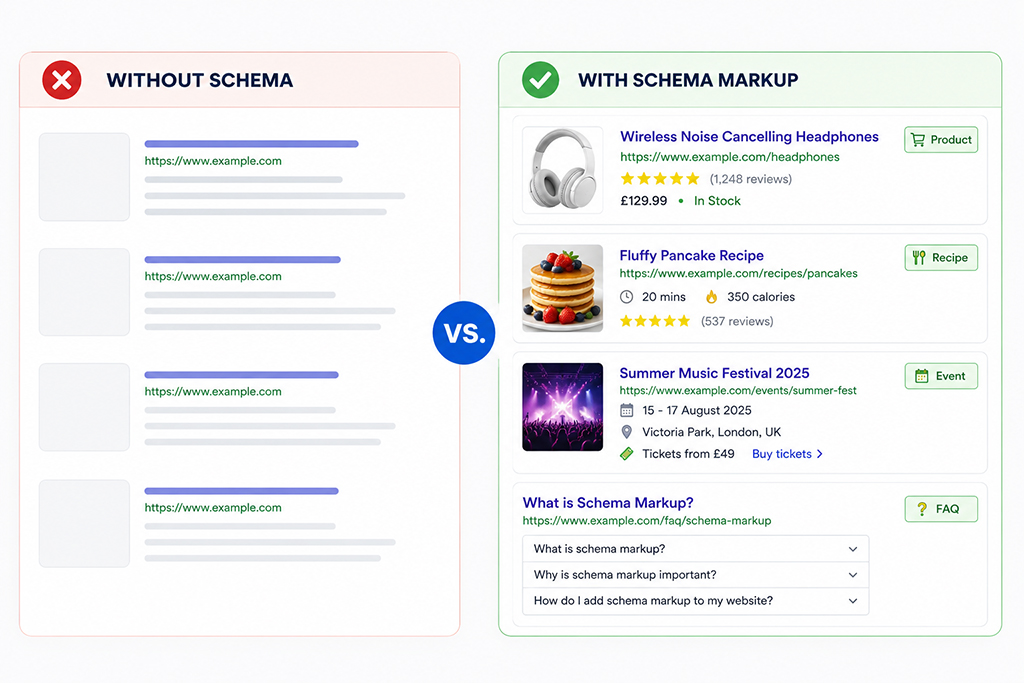
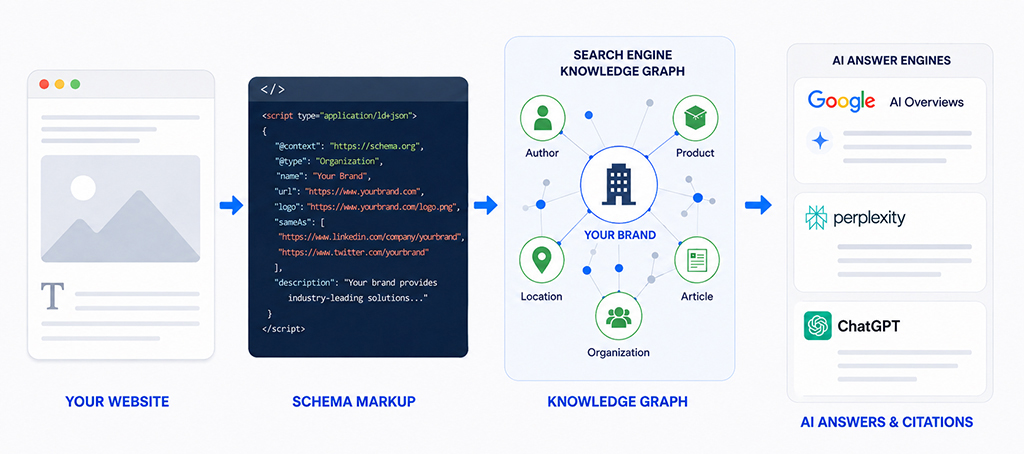
Search is undergoing a massive shift toward artificial intelligence. Search engines and AI answer engines – like Google AI Overviews, Perplexity, and ChatGPT – do not just scan for keywords; they map relationships between real-world entities.
Schema provides machine-readable context. By using standardized definitions, you help search engines index your brand, authors, and products into their Knowledge Graphs. When an AI tool needs to summarize the top experts or products in your niche, structured data ensures your brand is clearly understood and cited.
3. Bulletproof Local SEO & Brand Authority
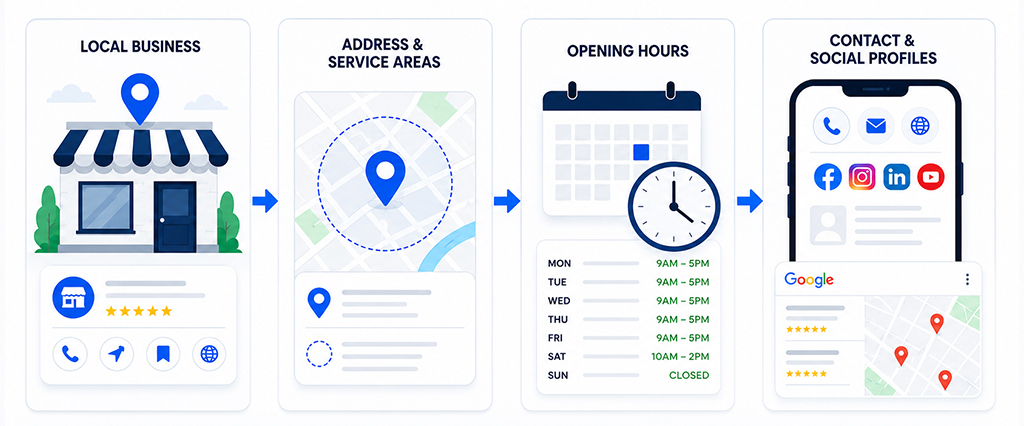
For local businesses, visibility in Google’s Map Pack is critical. Implementing LocalBusiness schema allows you to explicitly communicate:
- Exact physical addresses and service areas
- Precise opening hours (including holiday schedules)
- Contact numbers and social media profiles
This prevents search algorithms from misinterpreting scraped third-party data and ensures your business information displays accurately across Search and Maps.
4. Higher-Intent Traffic and Lower Bounce Rates
When users see key details – like pricing, reviews, or prep times – before they click on your link, they make an informed choice.
Someone clicking a product listing that already displays a 4.8-star rating and a $49 price tag is far more qualified than a random visitor. The result? Higher conversion rates, lower bounce rates, and longer dwell times – signals that tell Google your page provides immense value.
Top Schema Types Every Website Should Implement
You don’t need to markup every line of code on your site. Start by focusing on the schema types relevant to your business model:
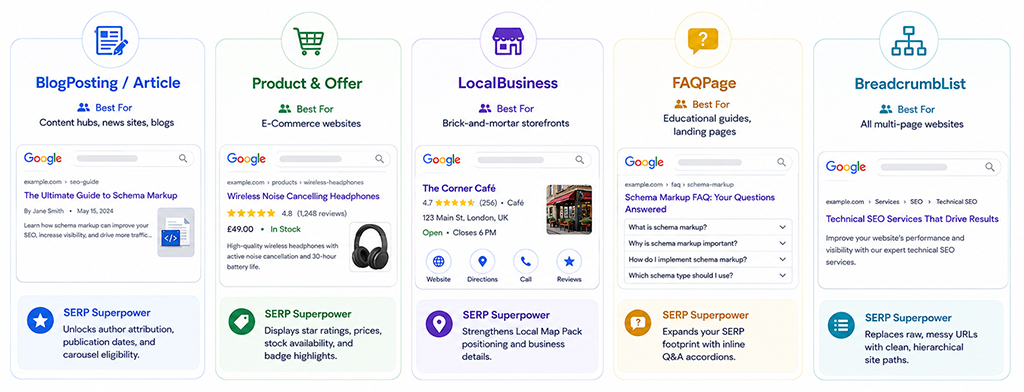
| Schema Type | Best For | SERP Superpower |
|---|---|---|
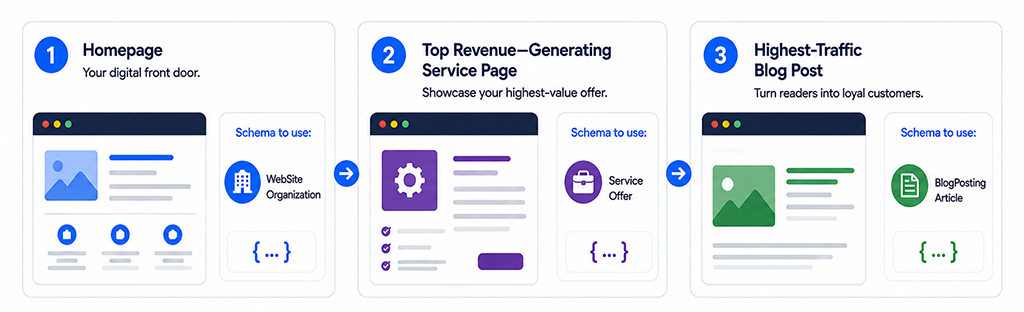
| BlogPosting / Article | Content hubs, news sites, blogs | Unlocks author attribution, publication dates, and carousel eligibility. |
| Product & Offer | E-Commerce websites | Displays star ratings, prices, stock availability, and badge highlights. |
| LocalBusiness | Brick-and-mortar storefronts | Strengthens Local Map Pack positioning and business details. |
| FAQPage | Educational guides, landing pages | Expands your SERP footprint with inline Q&A accordions. |
| BreadcrumbList | All multi-page websites | Replaces raw, messy URLs with clean, hierarchical site paths. |
How to Implement Schema Markup (Without Being a Developer)
Implementing structured data sounds intimidating, but modern tools make it remarkably simple.
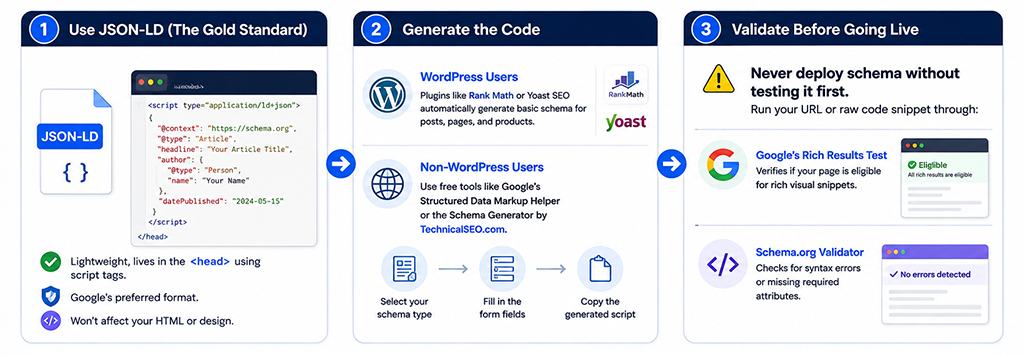
Step 1: Use JSON-LD (Best Practice)
There are a few ways to write schema, but JSON-LD (JavaScript Object Notation for Linked Data) is Google’s preferred format. It is lightweight, lives cleanly inside script tags in the head of your page, and won’t mess up your HTML layout or visual design.
Step 2: Generate the Code
You do not need to write code from scratch:
- WordPress Users: Plugins like Rank Math or Yoast SEO automatically generate basic schema for posts, pages, and products.
- Non-WordPress Users: Use free tools like Google’s Structured Data Markup Helper or the Schema Generator by TechnicalSEO.com. Simply select your schema type, fill in the form fields, and copy the generated script.
Step 3: Validate Before Going Live
Never deploy schema without testing it first. Run your URL or raw code snippet through:
- Google’s Rich Results Test – Verifies if your page is eligible for rich visual snippets.
- Schema.org Validator – Checks for syntax errors or missing required attributes.
Final Thoughts: Don’t Let Your Competitors Take the Real Estate
In a search landscape crowded with ads, AI summaries, and organic listings, schema markup gives you control over how your brand appears to the world. It bridges the gap between human readability and machine understanding.
Need help getting your schema right?
Schema markup can make your website clearer to search engines, strengthen your visibility in search and give AI platforms better context about your business. But choosing the right schema types, implementing them correctly and validating the markup can quickly become technical.
MATM can help.
We can review your existing structured data, identify the biggest opportunities across your website and implement the schema that makes sense for your pages, products, services, locations and content.
From technical SEO audits and implementation through to ongoing SEO and GEO support, we’ll help make sure your website is giving search engines the clearest possible picture of who you are and what you offer.
For help managing your schema, contact matm at [email protected] or call 01952 883 526.